

The gym mirror used to be honest.
You stood in front of it because you wanted larger shoulders, or because your doctor said your cholesterol was bad, or because your ex left and your body became the battlefield where you tried to reverse the verdict. The mirror reflected a problem. You solved it or you didn't. Nobody thought this was philosophy.
Now the mirror talks back.
It says you are "doing the work." It says your morning routine is a moral act. It says your hydration, your supplements, your cold plunge, your sleep optimization, your six-hour podcast queue, your perfectly calibrated protein intake, your journaling habit, your dopamine fast, your meditation streak, your "healing journey," your digital detox, your attachment style awareness, your ten thousand bookmarked clips about discipline, all of it means something larger than vanity.
The old narcissist loved his reflection.
The new narcissist loves his improvement.
This matters because self-improvement sounds like humility. Narcissism sounds like excess. One appears disciplined, the other indulgent. One wakes up at 5 a.m., the other posts shirtless selfies. But psychologically they often orbit the same sun. Both are trapped by obsessive self-reference. Both convert life into a mirror.
The difference is aesthetic.
The classic narcissist says, "Look at me."
The modern self-improvement addict says, "Look how hard I'm working on myself."
He thinks this second sentence absolves him.
It doesn't.
A man spends four hours researching the ideal productivity system. He reads about habit loops. He color-codes calendars. He purchases notebooks expensive enough to imply seriousness. Every hour gets assigned a task. Every task receives a metric. Then he sits alone at night refreshing YouTube clips about focus while his girlfriend eats dinner in the other room.
He calls this growth.
But growth toward what?
That question ruins the entire industry.
Because most self-improvement has detached itself from any external purpose. It no longer exists to make you useful to other people. It exists to intensify your relationship with yourself. The self becomes both patient and physician, product and consumer, worshipper and deity.
You can watch the shift happen historically.
Older moral systems judged people by obligation. Did you take care of your children. Did you keep your word. Did you contribute something beyond your appetites. Even religion, for all its neuroses, forced attention outward. Sin involved your relationship to God, family, neighbor, community.
Modern therapeutic culture changed the axis.
Now the central question is whether you are becoming your "highest self." Every action bends inward for evaluation. How does this affect my growth. My healing. My boundaries. My optimization. My journey.
Notice the vocabulary. It sounds medical and spiritual at the same time. That is not accidental. Therapy language became the replacement religion for people who distrust religion but still crave moral legitimacy.
So vanity learned clinical terminology.
A woman cuts off half her friends because they "drain her energy." A man abandons responsibilities because he is "protecting his peace." Somebody ghosts a relationship after reading two Instagram slides about attachment trauma. The language sanitizes selfishness. What would once have looked immature now looks psychologically informed.
And because the language sounds compassionate, nobody notices the obsession underneath.
The obsession is the self.
Not the soul. Not character. The self as object of endless management.
Historian and social critic Christopher Lasch wrote about the culture of narcissism decades ago. He saw people turning inward after institutions collapsed. Family weakened. Religion weakened. Political trust evaporated. Work became unstable. People lost durable identities. So they became fascinated with personality instead. Identity became a performance requiring constant maintenance.
Social media accelerated this pathology until it became invisible.
Now everyone curates themselves the way corporations manage brands. The average person has a public relations department in his pocket. Every experience passes through a hidden question.
How does this reflect on me?
Even suffering becomes branding material. Especially suffering.
Watch how people narrate pain online. They rarely describe grief directly. They describe their growth through grief. They package devastation into content. The breakup becomes a carousel post about lessons learned. Addiction becomes a redemption arc. Anxiety becomes a personality architecture with educational infographics.
Nothing stays private long enough to transform into wisdom.
Experience gets monetized before it gets understood.
This infects self-improvement at every level. The gym is no longer a place where people train. It is a stage where people document training. Reading books becomes evidence of seriousness. Meditation becomes identity decoration. Half the productivity industry consists of men displaying systems they never actually use.
The performance consumes the activity.
You can tell because many people spend more time discussing self-improvement than practicing it. The discussion itself provides the emotional reward. Talking about discipline produces the sensation of discipline. Planning replaces action because planning allows infinite fantasy without risk of failure.
A man with seventeen tabs open about entrepreneurship feels entrepreneurial.
A woman reorganizing her "future goals" board feels transformed.
Nothing has happened.
But psychologically something has happened. They have converted uncertainty into temporary self-soothing. The fantasy of future perfection protects them from present inadequacy.
That protection becomes addictive.
Freud noticed something uncomfortable about human beings. Symptoms often solve emotional problems. Anxiety, compulsions, avoidance, grandiosity, these are not random defects. They defend the psyche from conflict.
Self-improvement often functions this way.
The obsession with becoming better protects people from confronting ordinary life. Real life contains limits. Marriage forces compromise. Children interrupt narcissism. Friendship demands tolerance. Work humiliates you. Aging closes doors. Community requires obligation toward people you did not personally select according to your "values."
Self-improvement offers escape from all that.
You don't have to become dependable if you are eternally "working on yourself." You don't have to commit if you are still evolving. You don't have to love people consistently if you can frame every discomfort as misalignment.
Perpetual self-construction becomes avoidance.
Notice how many people today speak about themselves as unfinished projects. They are always entering a new phase. Healing. Reinventing. Resetting. Recalibrating. Optimizing.
Always preparing to live.
Rarely living.
The language sounds active but produces paralysis because perfection has no endpoint. There is always another protocol, another framework, another hidden flaw demanding correction.
The body becomes especially vulnerable to this logic because the body offers visible metrics. Weight. Muscle mass. Skin quality. Sleep scores. Hormone levels. Step counts.
The quantified self feels comforting because numbers imply control.
But eventually the body stops being your body. It becomes a surveillance project.
People no longer exercise to experience strength. They exercise to reduce anxiety about inadequacy. Missing one workout feels morally dangerous. Eating dessert creates guilt disproportionate to the act itself because the food is no longer food. It is evidence. Evidence that you are failing your potential.
Potential is the cruelest religion ever invented.
At least older religions understood limitation. Human beings were flawed creatures trying imperfectly to orient themselves toward goodness. The modern self-help world rejects limitation almost entirely. Every flaw becomes improvable through enough discipline and correct information.
So failure becomes personal indictment.
If your life remains empty, you must not be optimizing hard enough.
This creates a strange psychological loop. The more people focus on themselves, the less coherent they become. Because identity built through endless self-monitoring grows unstable. Every emotion requires interpretation. Every interaction becomes diagnostic data. The person develops exquisite awareness of internal states while losing contact with external reality.
They know their attachment style but cannot comfort a grieving friend.
They can label their cognitive biases but cannot sustain intimacy.
They track macros while ignoring alcoholism.
They meditate daily while treating waiters like dirt.
This is not hypocrisy in the normal sense. It is fragmentation. Moral development has been replaced by self-management techniques. Character gets confused with optimization.
But optimization toward what?
Again the question returns.
A healthy psychology usually involves forgetting yourself sometimes. Not hating yourself. Not suppressing yourself. Forgetting yourself.
You see this in people absorbed by meaningful responsibility. A good nurse during an emergency. A father teaching his daughter to ride a bike. A carpenter concentrating on the grain of wood. An athlete fully immersed in competition. A musician disappearing into performance.
The self recedes.
Modern self-improvement culture cannot tolerate this disappearance because it interprets every activity through self-enhancement. Even hobbies become instrumentalized. Reading fiction becomes "mental expansion." Walking becomes “nervous system regulation." Friendship becomes “networking.”Rest becomes “recovery optimization.”
Nothing can simply be.
Everything must improve the self somehow.
This is why so many optimized people seem exhausted. Their consciousness never leaves the managerial position. They supervise themselves endlessly. Internal monologue becomes middle management.
Eat this.
Track that.
Correct this thought.
Improve this trait.
Fix this weakness.
The psyche turns into a corporation conducting annual performance reviews every hour.
Then people wonder why they feel alienated from themselves.
The alienation comes from treating the self as machinery instead of mystery. Human beings cannot survive permanent self-objectification. Eventually the observing mind and the living mind split apart. One performs life while the other audits it.
You can hear the split in contemporary dating language. People assess each other like HR departments. Red flags. Green flags. Emotional availability. Trauma responses. Compatibility metrics. Standards.
Everyone sounds employable.
Nobody sounds in love.
The self-improvement industry encourages this because insecure people are profitable. A person who finally accepts ordinary human limitation buys fewer products than a person trapped in endless self-repair.
That does not mean all self-improvement is fraudulent. Some people need discipline. Some need therapy. Some need to stop drinking, start exercising, leave abusive relationships, develop skills, read difficult books, build routines.
But healthy improvement eventually exits self-consciousness.
The goal of confidence is not confidence. The goal is freedom from thinking about yourself constantly.
A strong body should return you to life, not imprison you inside calorie spreadsheets.
Therapy should increase your capacity to love other people, not merely analyze your childhood with better vocabulary.
Discipline should make commitment possible, not turn existence into a military occupation against your impulses.
Real growth reduces narcissism because it increases contact with reality. Fake growth intensifies narcissism because the self remains the central object of fascination.
You can usually distinguish the two by one trait.
The healthy person becomes more available to others.
The unhealthy person becomes more obsessed with maintaining his personal equilibrium.
One forgets himself in meaningful activity.
The other monitors himself endlessly.
There is a reason people trapped in self-improvement culture often describe feeling strangely hollow after reaching goals. The achievement cannot satisfy because the structure itself is self-consuming. Every completed milestone generates another deficiency. The entire system depends on dissatisfaction continuing forever.
The mirror must keep talking.
And maybe that is the clearest sign something has gone wrong.
A healthy mirror eventually disappears. You check your reflection, adjust your collar, leave the bathroom, go live your life.
You do not build a religion around the glass.
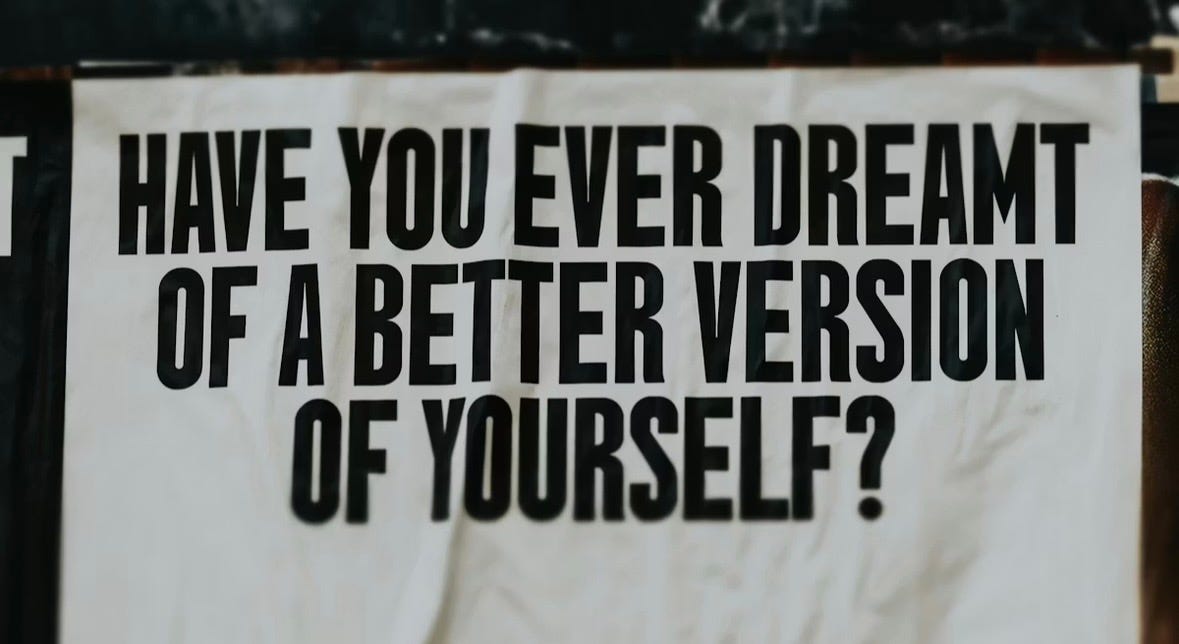
*photo credit goes to Jon Tyson
I really appreciated your piece because it expresses exactly what I think about this topic. It feels like personal growth is becoming a trend exploited by marketing, and people don’t notice it, because real awareness doesn’t actually come from that.
Really thoughtful piece. I especially appreciated the distinction between genuine growth and endless self-management disguised as growth. “The goal is freedom from thinking about yourself constantly” was a particularly strong line.