
When I was in AP Literature, our teacher assigned us a fictional short story. I no longer remember the prompt. I only remember deciding to write about something I knew.
The story was about siblings living with a mother whose moods controlled the entire house. Sometimes she flew into a rage. Other times she stayed in bed for days. The children learned to move silently. They learned how to make themselves small.
Food was often scarce. There were days when the kitchen held little more than ketchup, mustard, and an old container of freezer-burned ice cream that nobody liked. Hunger became so familiar that it barely registered. The children hid in a bedroom reading books while their mother slept, afraid to open the door and afraid to make enough noise to wake her.
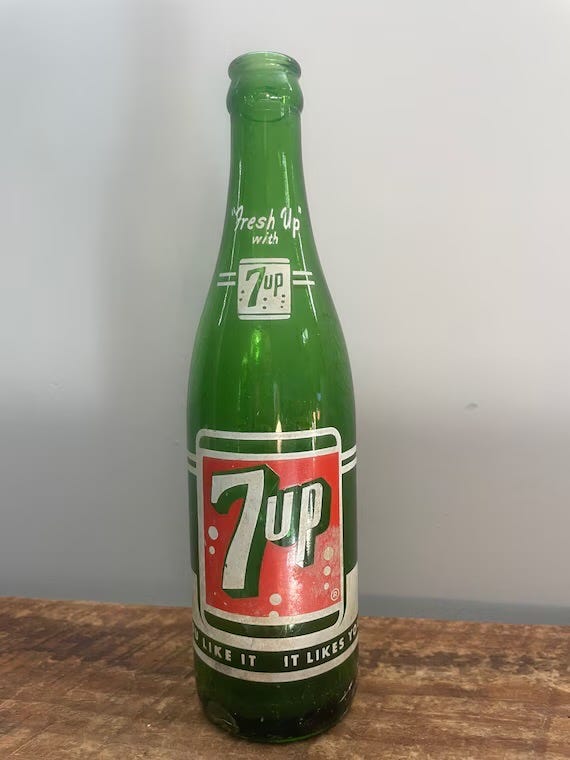
At one point in the story, a younger brother needed to use the bathroom. His sister handed him an old 7 Up bottle sitting on the bedroom windowsill. I remember writing that detail because the bottle was real. Everything in the story was real.
Someone in class asked whether we would have to read our stories aloud. The teacher said no. Relief washed over me.
I hated speaking in front of people, but that wasn't the whole story. By then, I had already learned something about survival. Staying safe meant staying unseen. Staying unheard. My mother had made that lesson clear long before I stepped into that classroom.
I wasn't worried my teacher would recognize the story as true. My mother had protected us from that possibility. No matter what was happening inside our home, we looked good on the outside. We wore clean clothes. We got good grades. We appeared normal.
My mother had anorexia. Appearance was a priority. Food was not.
For much of my childhood, we ate one meal a day. Sometimes less. Yet somehow none of that was visible. I wrote the story believing only one person would ever read it. My teacher.
The day our assignments were returned, my teacher made an announcement. He had changed his mind. There was one story he wanted to share with the class because it had stood out to him.
I remember the immediate rush of panic.
Please don't be mine.
I lowered my head and closed my eyes. Looking back, it seems absurd, but there was a part of me that still believed invisibility was possible. If I made myself small enough, perhaps I could avoid being chosen.
Then he said my name.
The room tilted. My heart pounded so hard I could hear blood rushing through my ears. I don't remember lifting my head. I don't remember looking at anyone. I only remember terror.
Thankfully, he didn't ask me to read it. He read it himself.
As he spoke, I sat frozen in my chair. Every sentence felt like exposure. What if someone recognized the story? What if they understood it wasn't fiction? What if they called the police? What if they called my mother?
I wasn't proud that my story had been selected. I wasn't excited. I wasn't thinking about writing or talent or recognition.
I wanted to disappear.
That desire wasn't new. It had been with me for as long as I could remember.
People often talk about childhood dreams. They wanted to be astronauts or teachers or veterinarians. I didn't spend much time imagining a future. Most of my energy went toward a single question. How do I get as far away from this family as possible?
Distance was the dream.
Escape was the dream.
Maybe writing could have become something else for me. Maybe it could have become a way out. I don't know. Whatever possibility existed died in that classroom.
My teacher finished reading the story.
Nothing happened.
Nobody called the police.
Nobody called my mother.
Nobody approached me after class.
Nobody recognized the story as true.
That may be the strangest part.
I had written down my life and hidden it in plain sight. The details were all there. The hunger. The fear. The silence. The children trapped in a bedroom trying not to exist loudly enough to attract attention.
Everyone accepted the fiction.
The story was visible. I was not.
For years afterward, I thought about that day whenever writing came up. Not in a conscious way. More like a reflex. A hand touching a hot stove and pulling away before the mind has time to catch up.
Writing had become associated with exposure.
Exposure had become associated with danger.
The equation felt settled.
I left home. Built a life. Went to graduate school. I spent years helping other people find language for experiences they had never spoken aloud.
Meanwhile, I kept many of my own words to myself.
Looking back, I don't think I stopped writing because my story was read in front of the class. I think I stopped because some part of me realized writing had the power to make me visible.
The story escaped.
That was enough.
Children make strange promises to themselves. Nobody witnesses the moment. There is no ceremony. A child decides never to cry again. Another decides never to ask for help. Another decides never to need anyone.
At some point, I made a promise too.
No one would ever read my writing again.
I carried that promise for decades. Long enough to forget I had made it.
And then, somehow, I ended up here.
Writing on Substack. Publishing things I never imagined I would share. Hitting publish and waiting for strangers to read words that once felt too dangerous to put on a page.
Sometimes I still think about that girl sitting in her classroom with her eyes closed, hoping nobody would say her name.
The difference is that now I say it first.
Thank you for this gift of vulnerability, Andie. I can’t imagine what it must have felt like growing up in that manner.💔
I’m honored to be getting to know you. You’re a force to be reckoned with. 🙌
And as I’ve told you a few times already, I love the clarity and powerful imagery of your prose.
When I see your name on my Substack feed, whether it’s one of your articles or notes, I get a jolt of happy anticipation. I’m so grateful that you transcended “never again.” 😊
We used to worry about being seen, about the possibility that someone might understand too much. But as an adult I’ve realized that it takes a particular kind of soul to truly see you, and not everyone has that ability.
It hurts me when I read emotions I know too well, and at the same time I’m grateful that despite everything you’ve faced, you’ve met your difficulties with courage and kept moving through life, giving the best of what you can each day.
I’m glad I get to read you again.